

Get in Touch
Optimization of Cling Properties in PE Films for Cold Storage
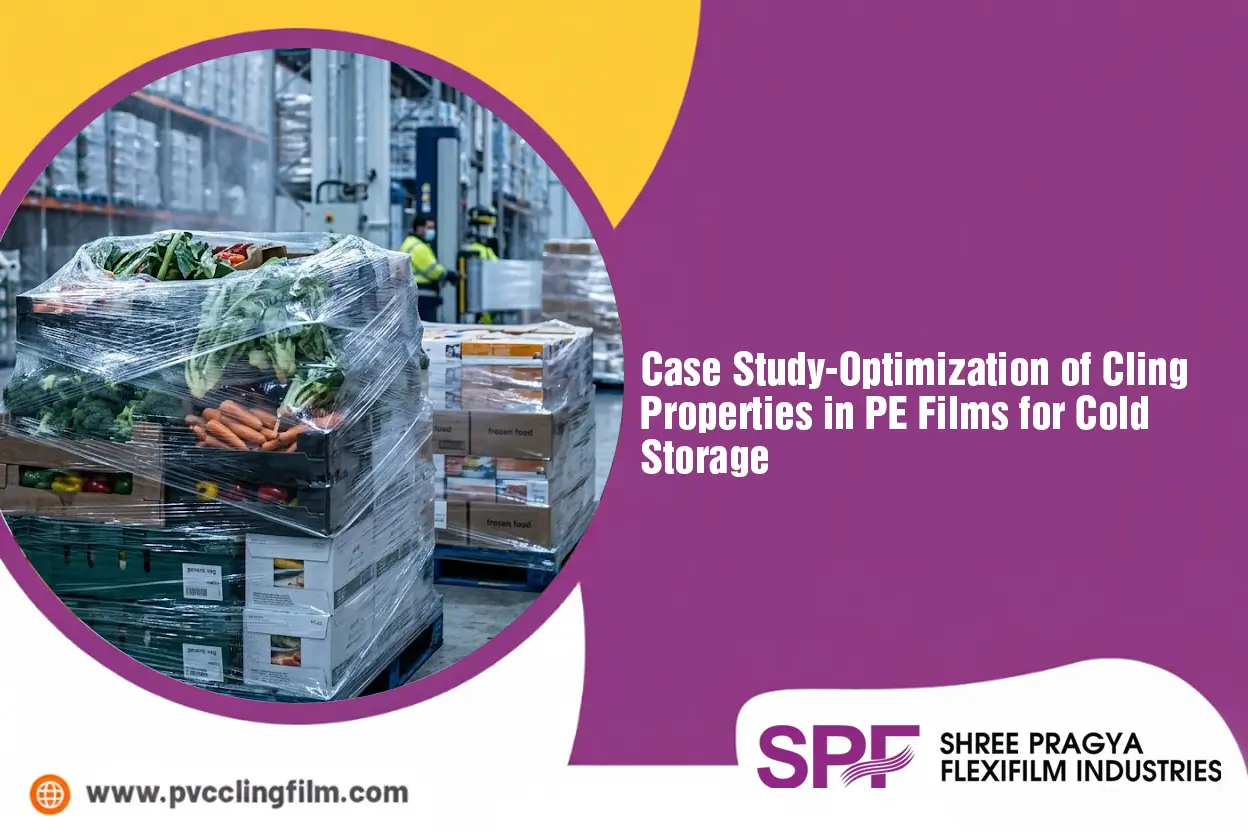
This case study documents our technical journey at Shree Pragya Flexifilm Industries in developing and optimizing PE cling films specially engineered for cold storage and refrigeration food preservation environments. We approached a critical industry challenge: standard PE films, while being cost-effective and food-contact safe, might face degradation in cling force and flexibility at sub-ambient temperatures.
Through systematic polymer formulation research, resin blending strategies and additive optimization, deployment of food-grade masterbatch technology, Shree Pragya achieved a PE film that sustains cling performance down to -40 °C while maintaining full compliance with FDA and EU food-contact standards. The result is a product that has significantly enhanced food shelf life outcomes for clients in the cold chain, retail and commercial food service sectors.
The Cold Chain Packaging Problem
The global cold chain packaging market is driven by the expanding need to maintain food quality from production to consumption. Cling film becomes a problem in this chain as the polymer properties conform to cling performance in refrigerated environments. Standard LDPE undergoes a subtle but significant change at lower temperatures. The increased chain rigidity reduces the viscoelastic surface tack that gives cling films their self-adhering character. The result is peeling, gapping or complete loss of seal integrity; each of these accelerates moisture loss, oxidation and microbial spoilage in the wrapped product.
Technical Deep Dive: Polymer Science of Cold-temperature Cling
Understanding Cling Mechanisms in PE Films
➤ Viscoelastic Surface Tack: The ability of the film surface to flow slightly and form intimate molecular contact with the substrate.
➤ Electrostatic Adhesion: Charge accumulation on the film surface, which is temperature-sensitive and humidity-dependent.
➤ Mechanical Conformability: The film’s ability to deform and match the topography of irregular food surfaces or container rims.
At colder temperatures, all three cling mechanisms are compromised. The Glass Transition Temperature (Tg) of LDPE is approximately -100 °C, which provides theoretical flexibility. However, the practical cling force degrades even at +40 °C due to its reduced molecular mobility at the surface layer and increased film stiffness.
Resin Selection
As a leading PE cling film manufacturer in India, we at Shree Pragya Flexifilm Industries use LDPE/LLDPE blend as its base matrix with PE incorporated at a controlled ratio to improve optical performance and inter-layer uniformity critical for consistent seal quality across commercial food wrapping operations.
The Role of Additives & Masterbatch to Enhance Cling Performance
The decisive breakthrough in cold-temperature cling performance came from the systematic incorporation of performance additives and Polyisobutylene (PIB) masterbatch into the film formulation. PIB is a synthetic rubber-type polymer, along with polyethylene drives surface mitigation, creating a tacky, self-adhesive surface without requiring additional agents. This results in:
➤ Improved Cling Force: The migrated PIB layers maintain viscoelastic tack even at low temperatures, where the base PE surface mobility is reduced.
➤ Enhanced Low-temperature Flexibility: PIB’s elastomeric character suppresses the stiffening of the film at refrigeration temperatures.
➤ Self-adhesion: It allows for clean dispensing from rolls even after prolonged cold storage.
➤ Sustained Cling Development: Cling forces increase approximately 2 weeks post manufacturing as PIB migrates.
PIB masterbatch is food-safe, hydrophobic, stable and compatible with standard LLDPE extrusion lines.
Anti-Fog Additive Systems for Cold Storage Visibility
Another vital challenge in cold storage environments is condensation management. When warm food is wrapped and placed in the refrigerated display or storage cabinet, the temperature differential drives moisture to condense on the inner film surface. This creates an opaque, hazy appearance that degrades product presentation and visual hygiene perception.
Shree Pragya’s PE cling film incorporates anti fog additives that work through a surfactant mechanism. The anti fog agent migrates to the film surface and lowers the water contact angle, causing moisture to spread into a thin, transparent film rather than forming light-scattering droplets.
The Optimization Process
Phase 1: Formulation Mapping
The technical team begins with a Design of Experiment (DoE) approach, systematically varying masterbatch loading (2%, 4%, 6%, 8% by weight), LDPE/LLDPE blend ratio (70:30, 60:40, 50:50), processing temperature profile and blowup ratio during blown film extrusion.
Phase 2: Cold-temperature Performance Testing
| Formulation | MB% | LLPDE: LDPE | Cling Force | Haze% |
| Standard | 0 | 70:30 | 42 | 4.8 |
| Trial A | 2% | 70:30 | 68 | 4.2 |
| Trial B | 4% | 65:35 | 89 | 3.8 |
| Trial C | 6% | 60:40 | 112 | 3.5 |
| Trial D (optimized) | 6% | 55:45 | 128 | 2.9 |
Phase 3: Process Parameter Optimization
The blown film extrusion process was fine-tuned to ensure uniform MB distribution and consistent surface migration behaviour:
➤ Die Temperature: Set 5°C lower than standard LDPE processing to preserve MB molecular weight distribution and minimize premature surface segregation.
➤ Blow-up Ratio (BUR): Optimized at 2.8:1 to balance film clarity with mechanical orientation that enhances puncture resistance at low temperatures.
➤ Cooling Tower Distance: Extended by 15% to allow more controlled crystallization of the LLDPE phase, improving cold-temperature elongation retention.
➤ Winding Tension: Reduced by 12% to prevent blocking during roll storage in warm climates prior to dispatch to cold chain customers.
Results & Measured Impact
➤ Cling Performance: 128 g/25mm
➤ Elongation: 410%
➤ Haze: 2.9%
➤ Strong Moisture Barrier: <3.2 g/m3/day
Wrapping Up
This case study demonstrates that the optimization of cling properties in PE films for cold storage is both technically achievable and commercially compelling. Through systematic polymer formulation science, specifically the strategic use of masterbatch in an LLDPE/LDPE/ blend matrix, combined with a precision anti-fog additive system, Shree Pragya Flexifilm Industries has developed a PE cling film that performs reliably across the full cold chain temperature spectrum.
For cold chain operators, retailers, and commercial kitchens seeking a packaging solution that reduces food waste, improves product presentation, and meets the most stringent food safety and sustainability standards, Shree Pragya’s cold-storage PE cling film represents a technically superior and commercially accessible solution.
Also Read: Effect of Cling Film Thickness and Clarity on Shelf Appeal and Food Preservation