

Get in Touch
How a Cheese and Dairy Processor Extended Product Shelf Life Using Greaseproof Parchment Paper Wrapping
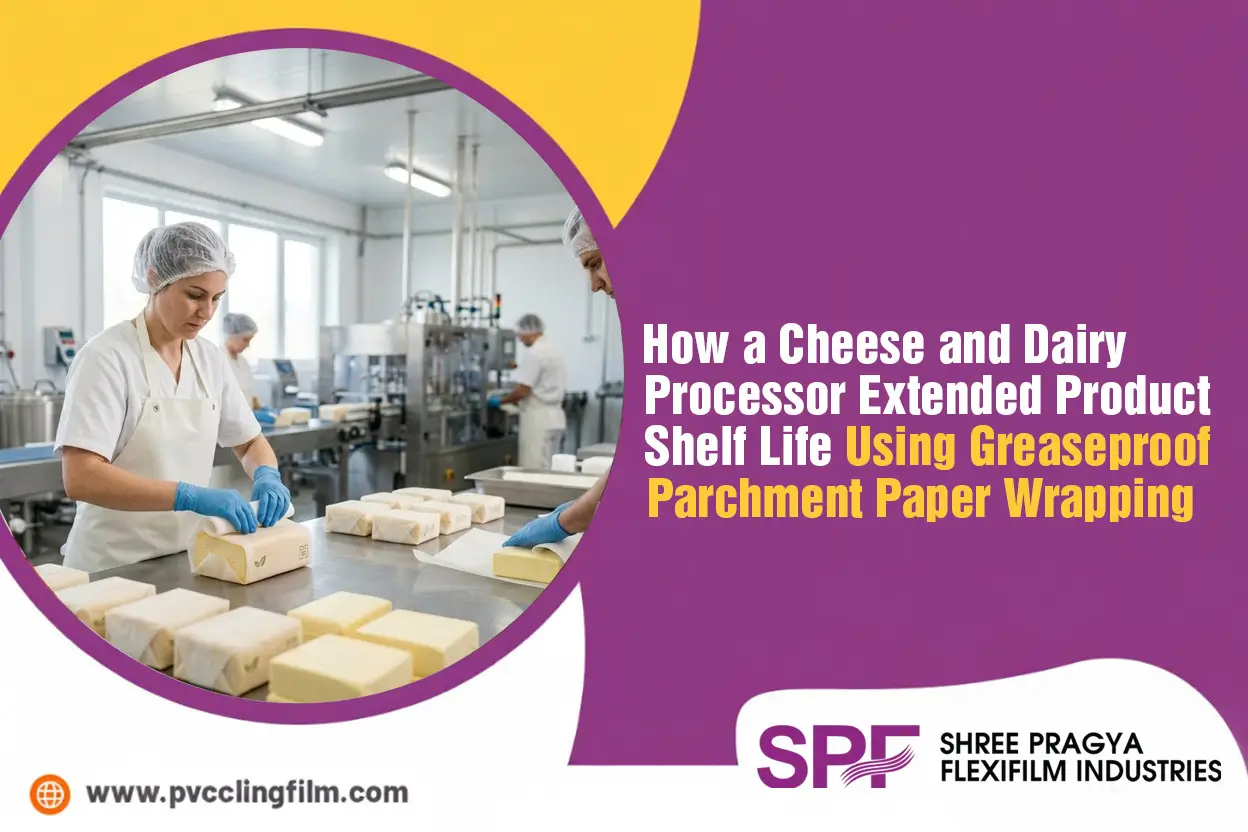
India is the home to one of the world’s largest dairy ecosystems. The cooperative and private dairy networks across Gujarat, Maharashtra, Uttar Pradesh, Madhya Pradesh, and Rajasthan collect millions of litres of milk daily. This, in turn, supports processing into cheese, paneer, butter, ghee and flavoured dairy products. With the most advanced Indian dairy supply chain, from automated milking equipment to state-of-the-art cold storage, one part of the supply chain lagged behind something important: the wrapping material used at the point of processing and dispatch. This is when parchment paper enters.
The Challenge
At Shree Pragya Flexifilm Industries, as a leading food packaging material manufacturer, we help all our clients find the right packaging material for their applications. In this case study, a mid-size cheese and dairy processor experienced a common problem. Cheese and paneer products were leaving the facility in good condition, but upon arriving at retail and HORECA, customers experienced visible mould, surface sweating and foul odour within 5 to 7 days. The return rates were increasing, and a retail store had issued a formal complaint. The management team knew the problem was the packaging. What they did not understand was exactly which properties were failing, and what to replace them with.
| Failure Point | Root Cause | Business Impact |
| Mould & Surface | Condensation trapped in plastic film | Returns, complaints |
| Spoilage | Plastic film wrap | High risk |
| Grease bleed-through | Non-grease wax liner | Structural wrap failure, staining |
| FSSAI non-compliance | Non-certified food-contact additives in wax wrap | Product line risk |
| Short shelf-life (7-9 days) | Combined moisture + contamination effect | Revenue loss, cold chain pressure |
The Solution: Greaseproof Parchment Paper
The procurement team reached out to several parchment paper manufacturers in India before approaching Shree Pragya for grease-proof parchment paper.
How Parchment Paper Addresses Each Failure Point
- Failure Point 1- Trapped Moisture/Condensation: The low air permeability in parchment paper allows controlled moisture vapour transmission. This releases the excess surface moisture rather than trapping it, maintaining the optimal surface humidity without drying the product.
- Failure Point 2- Grease Bleed Through: Treated with a silicon-coated greaseproof structure, which provides an excellent fat barrier that grease cannot permeate. This property helps maintain structural integrity and outer packaging cleanliness and hygiene throughout the shelf life.
- Failure Point 3- FSSAI Non-compliance: The plant cellulose-based and silicon-based coatings are classified as food-safe, non-toxic materials that meet FSSAI food-contact standards.
- Failure Point 4- Short Shelf Life: The combination of correct moisture management + fat barrier + absence of contamination pathways directly extends the viable shelf window for hard and soft cheeses
Why Parchment Paper Works for Dairy Products
The parchment paper is manufactured from plant cellulose and treated with parchmentsing process. It is immersed in sulfuric acid and neutralized which fundamentally changes the structure at the fibre level.
- Grease Resistant: Fats and oils cannot penetrate the cellulose matrix.
- Moisture Regulating: The food wrapping paper transmits moisture vapour at a controlled rate, preventing drying out and condensation build-up.
- Non-stick: The silicon coating prevents protein adhesion (crucial for paneer and soft cheeses).
- Heat & Freeze Stable: It maintains integrity from freezer temperatures (-400 C) to oven-safe temperatures (up to 2250 C).
- Biologically inert: Made from plant-based cellulose, there is no scope for chemical migration into food.
Measured Outcomes
Result 1: Shelf Life Extension
| Product | Previous Shelf Life | Post-switching Shelf Life | Improvement |
| Hard cheese | 9 days | 15 days | +6days |
| Paneer | 5 days | 8 days | +days |
| Butter | 21 days | 28 days | +7 days |
Result 2: Spoilage & Return Rate Reduction
The mould-related spoilage measured as a percentage of production batch flagged at retail or returns by customers, dropped significantly. From an average of 6.8% across affected product lines to 4.1% within the first 30 days and to 4.0% within 90 days.
Result 3: Packaging Cost Reduction
This result surprised the procurement team. The initial assumption was that switching to parchment paper would increase packaging costs. In practice, the opposite happened:
- Consolidation of Wrap Layers: For paneer, removing the plastic wrap outer layer and using parchment paper as a sole primary wrap reduced the material count from two components to one.
- Reduced Spoilage Waste Costs: An average of 2.8% point reduction in spoilage meant a meaningful recovery of production value.
- Elimination of non-compliant Wax Liner: The flagged wax paper was more expensive per unit than parchment paper.
Result 4: FSSAI Compliance
Shree Pragya Flexifilm Industries’s parchment paper was supplied with food-contact certification, non-toxic silicone coating and compliance with FSSAI food-contact material standards.
Ready to Extend Your Product Shelf Line?
If your daily operations are facing compliance issues, spoilage or grease-bleed through, we can supply the right parchment paper specification for your applications. Call us today to discuss your requirements.